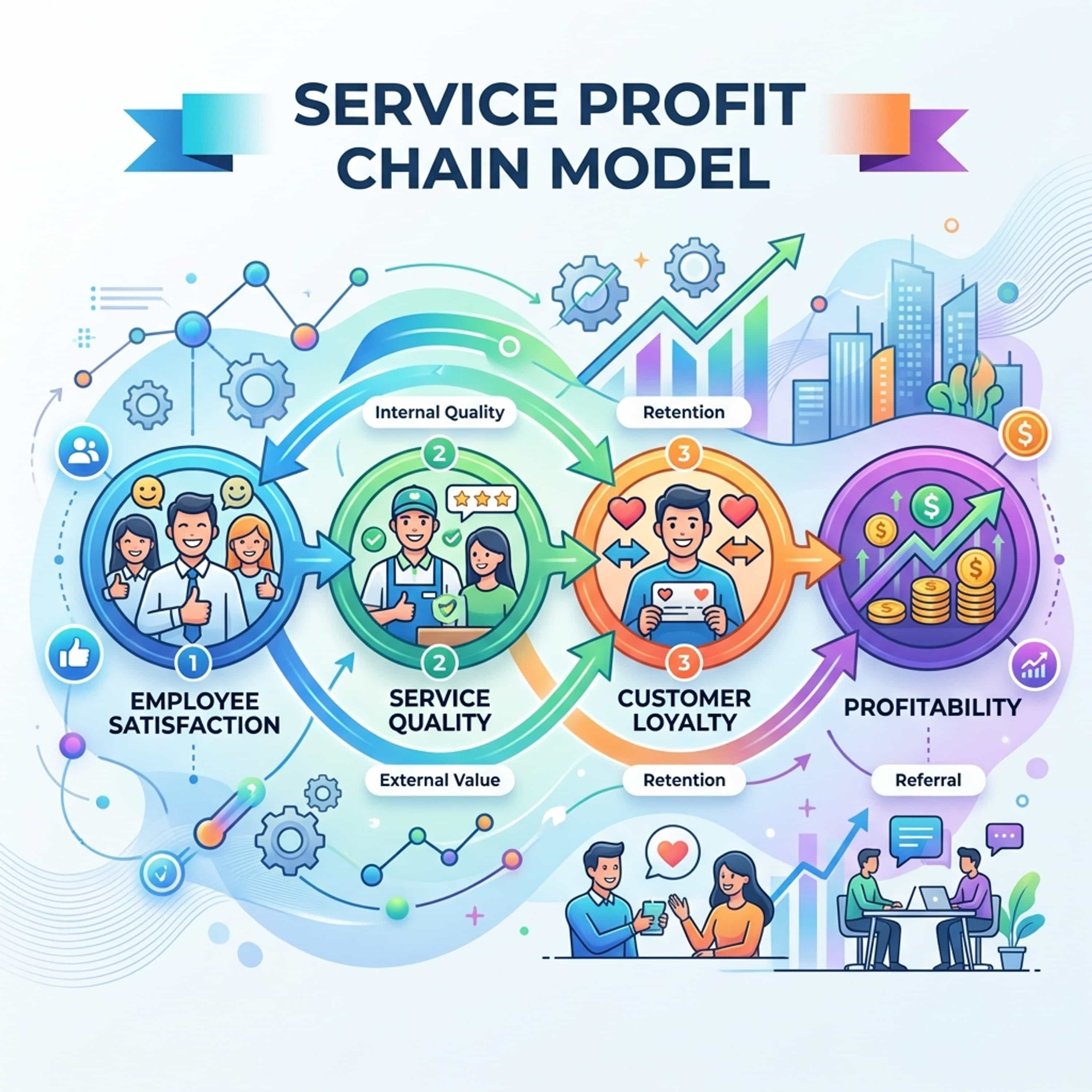
The Service-Profit Chain: Employees, Loyalty, and Growth
Explore how internal service quality, employee empowerment, and smart operations create better customer experiences that drive loyalty and profitability. This episode breaks down the value equation, NPS, and the virtuous cycle that turns satisfied teams into long-term business growth.
Is this your podcast and want to remove this banner? Click here.
Chapter 1
The Human Foundation of Profit
Dr. Linda Nelms
Welcome everyone! I am Dr. Linda Nelms. Today, we are diving into a concept that completely flips the script on how businesses generate and grow their profits. It is called the Service-Profit Chain Model. This model discusses key concepts that explain why some brands and business thrive while others crumble and fade away.
Dr. Linda Nelms
Let is start with a massive shift in perspective. Traditionally, if a business wanted more profit, the directive was simple: slash costs, squeeze the supply chain, or just push the sales team to sell, sell, sell. But in 1994, Harvard Business School professors James Heskett, Earl Sasser, and Leonard Schlesinger introduced a framework that proved true profitability actually starts somewhere entirely different. It starts with what they called Internal Service Quality. Think of this as the absolute bedrock of the entire chain.
Dr. Linda Nelms
Internal service quality is essentially how well an organization supports its own people. It is the training you provide, the technology you put in their hands, the workplace design, and the incentives. The core hypothesis here is beautiful in its simplicity: if you want happy, loyal customers who drive your profits, you must first have satisfied, loyal, and productive employees. And to get those employees, you have to build systems that allow them to thrive. It turns out, keeping your employees satisfied is not some soft, feel-good corporate favor -- it is a hard-nosed, strategic profit center.
Dr. Linda Nelms
But how does satisfied employee behavior actually translate into something a customer values? To understand that, we have to look at the Value Equation from the customer's perspective. The equation is a balance of four distinct variables: Result plus Process, divided by Price plus Effort. Let is break those down.
Dr. Linda Nelms
The "Result" is the primary need being met. If you are flying, the result is getting from point A to point B safely. The "Process" is how that result is delivered -- the ease, the friendliness of the staff, the atmosphere. "Price" is what the customer pays in cash, and "Effort" is how much work the customer has to do themselves.
Dr. Linda Nelms
Think about IKEA. In their value equation, the customer's "Effort" is incredibly high. You have to walk through a massive warehouse, cart the flat-packed boxes to your car, drive them home, and struggle with an Allen wrench to assemble a bookcase. But because your effort is so high, IKEA can drop the "Price" dramatically. On the flip side, think of a luxury hotel room service. Your effort is near zero -- you just press a button -- but you pay a premium price for that luxury. The magic of the Service-Profit Chain is that highly productive, satisfied employees are the ones who manipulate these variables to deliver stellar value, no matter which equation your business model uses.
Dr. Linda Nelms
And how do we get employees to deliver that value consistently? It comes down to empowerment. Look at Southwest Airlines, a classic Service-Profit Chain poster child. They famously tell their frontline employees: "You may do anything you are not uncomfortable doing to solve a passenger's problem." That is real empowerment! It is not about rigid scripts; it is about giving the frontline the freedom to act.
Dr. Linda Nelms
We see this in modern operations too, like small businesses replacing rigid, legacy phone systems with flexible virtual setups like Unitel Voice. It allows customer-facing teams to work remotely, reducing their commute stress while empowering them to professionalize their setup from anywhere. When you give employees the right tools and the authority to solve problems on the spot, they take pride in their work. That pride transforms into exceptional external service quality, which brings us to the next critical link in our chain: what happens when that value hits the customer.
Chapter 2
The Loyalty Compound
Dr. Linda Nelms
Now, you might assume that the relationship between customer satisfaction and customer loyalty is linear. You know, you make a customer a little happier, they become a little more loyal. But the data shows us something completely different. It is actually a hockey stick curve.
Dr. Linda Nelms
Picture a graph where the horizontal axis is satisfaction, from one to ten, and the vertical axis is loyalty. From deeply dissatisfied all the way up to "relatively happy" -- say, a score of seven or eight -- the loyalty line stays almost completely flat. These lukewarm, "satisfied" customers will leave you the second a competitor offers a slightly cheaper price. But once you cross into true enthusiasm -- scores of nine and ten -- the curve shoots straight up like the blade of a hockey stick. This is where Net Promoter Score, or NPS, becomes critical.
Dr. Linda Nelms
In the NPS framework, pioneered by Fred Reichheld, customers who rate you a seven or eight are "neutrals." They do not count. Those who rate you one through six are "detractors" -- they are actively damaging your brand. Only those who give you a nine or ten are "promoters." These are your enthusiastic fans. To find your NPS, you subtract the percentage of detractors from the percentage of promoters. Brands like Apple and Amazon boast massive scores in the seventies and eighties because they do not just satisfy customers; they delight them.
Dr. Linda Nelms
And why does this passionate loyalty matter so much to the bottom line? Because of the financial compounding effect. Loyal customers make businesses incredibly profitable through three main levers. First, lower acquisition costs. Keeping an existing customer is vastly cheaper than hunting for a new one. Second, word-of-mouth referrals. Your promoters become an unpaid, highly credible sales force. They do the selling for you.
Dr. Linda Nelms
And third, compounding brand equity makes your business less price elastic. When customers love your service and trust your brand deeply, they are far less sensitive to price increases. You can adjust your pricing to reflect your true value without losing your customer base.
Dr. Linda Nelms
This brings us full circle, closing the loop of the Service-Profit Chain. When loyal customers drive up revenue growth and profitability, a smart organization does not just pocket all that cash. They take a portion of those profits and reinvest them right back into the bottom of the chain -- into internal service quality. They buy better tools, design better training, and create a better working environment. This fuels even higher employee satisfaction, which restarts the entire virtuous cycle, driving the business to new heights.
Dr. Linda Nelms
It is a beautiful, self-reinforcing loop. So, as you study operations and design service delivery systems, remember: the spreadsheet metrics of profit and growth are lagging indicators. If you want to fix the top of the chain, you must start by polishing the bottom.
Dr. Linda Nelms
Unfortunately, that concludes our exploration of the Service-Profit Chain Model! To see how these concepts integrate with other concepts such as capacity planning, quality management, and process design, make sure to check out the other Operations Management episodes in your course resources. Until next time, I'm Dr. Linda Nelms. Keep learning, keep analyzing, and keep applying the principles of operations management, because every process improved, every decision optimized, and every problem solved creates opportunities for greater efficiency, innovation, and success in your every day activities and the world around you.